Skip to content
Search for a reverse osmosis system, and you will see the same pitch on repeat: count the filter stages, compare the prices, and pick the biggest number for the lowest cost. There is a reason it works that way, because that is the information most sellers put in front of you. The detail that predicts whether your system lasts is one almost nobody checks, which is who built it and whether they made the parts inside or just boxed up someone else’s.
QMP has been building American-made water filtration systems since 1994, and that one question reliably separates the systems that hold up from the ones that start leaking under the sink two years in. Here is how to think about it before you spend anything.
So what is a reverse osmosis system, really?
At its simplest, this kind of system pushes your tap water through a semipermeable membrane that blocks dissolved contaminants while letting clean water pass through. That membrane is the part doing the heavy lifting, and it separates this technology from the basic filters most people already own.
A carbon pitcher or a fridge filter mostly improves how your water tastes and smells. Reverse osmosis water goes further than that, because the membrane catches things at a scale a carbon filter was never designed to handle. So when someone asks what makes these systems different, the gap shows up in how much they remove from your water, well beyond taste.
How the system works, step by step;
Here is what happens once the water leaves your tap. A good reverse osmosis system runs your water through several stages in sequence, and each one has a specific job before the water reaches your glass. Skipping stages is where a lot of cheaper units cut corners, since more stages usually mean more cost to build.
The table below breaks down what each stage does and why it earns its place.
| Stage | What it does | Why it matters |
| Sediment pre-filter | Traps dirt, rust, and sand | Protects the finer filters from clogging early |
| Carbon filter | Reduces chlorine and organic chemicals | Removes taste and odor, guards the membrane |
| RO membrane | Blocks dissolved solids at a molecular level | Handles the actual contaminant removal |
| Post filter | Final polish before the faucet | Cleans up taste right before you drink |
| Remineralization stage | Adds beneficial minerals back in | Balances flat, stripped water and pH |
That last stage is worth pausing on, because reverse osmosis is thorough enough to strip out beneficial minerals along with the bad stuff. The reason that tradeoff matters becomes obvious once it is time to choose a system.
What it pulls out of your water
Most people picture chlorine when they think about water filtration, and chlorine is only the start. A well-made reverse osmosis system reduces a long list of contaminants that a basic filter leaves behind. Here are the ones worth caring about, and where they usually come from.
| Contaminant | Common source | Reduced by RO |
| Lead | Old pipes and solder | Yes |
| PFAS (forever chemicals) | Industrial runoff, firefighting foam | Yes |
| Arsenic | Natural deposits, groundwater | Yes |
| Nitrate | Fertilizer, agricultural runoff | Yes |
| Chlorine | Municipal treatment | Yes |
| Fluoride | Added to municipal supply | Yes |
PFAS is the one getting the most attention lately, and for good reason, since these forever chemicals keep turning up in water supplies across the country and a pitcher does nothing about them. This is exactly where single-stage filters fall short.
When Poosh asked Michelle Vidal, founder of the skincare brand AlkaGlam, to break down the types of filtered water, she explained that a basic carbon pitcher is “only good for removing chlorine for the most part.” The reason is contact time and the number of stages the water passes through, which a pitcher was never built to give you.
The EPA notes that reverse osmosis can reduce contaminants like lead, arsenic, and PFAS, and NSF-certified systems are tested to confirm it, which is a claim a countertop pitcher cannot make. There is one honest tradeoff to mention, though, because that same membrane also removes the good minerals your body actually likes.
| If you are not sure what is even in your water, that is the right question to start with, and our team is glad to help you figure it out before you spend a dollar. You can reach the people who build these systems and talk it through whenever you want. |
The part nobody checks: who built your system
Most brands just assemble imported parts
This is the part of the industry most people never see. A lot of the brands you find selling reverse osmosis systems online do not manufacture anything themselves. They source membranes, housings, and faucets from overseas suppliers, then assemble or simply rebrand them under a new logo. Nothing about that is illegal, and plenty of those systems work fine on day one. The problem shows up later, because when a part fails, there is often nobody who can tell you why it was built that way or stand behind fixing it.
Why QMP builds the whole thing in-house
This is where QMP works differently from most of the market. Founder Freddy Vidal started the company in Valencia, California, in 1994. QMP manufactures its own components under one roof, from the injection molding and CNC machining to the faucets, housings, and cartridges that go inside every system.
That vertical control is the reason companies like Home Depot, GE, and Culligan have trusted QMP for OEM manufacturing over the years. When a manufacturer builds every part itself, it can hold quality to a single standard, keep replacement parts available for years, and answer for how a system performs long after the sale.
| What to compare | Assembled import system | QMP vertically manufactured |
| Who makes the parts | Various overseas suppliers | Made in-house under one roof |
| Quality control | Varies by supplier | One standard, start to finish |
| Replacement parts | Often hard to source later | Kept available for years |
| Accountability | Spread across the supply chain | One manufacturer stands behind it |
| Longevity | Unpredictable | Built for long service life |
Which system fits your home
So how do you pick the right one for your home? Most homeowners do not need the biggest system on the shelf; they need the one that matches their kitchen and their water. Here is a simple way to think about the main types before you buy.
| System type | Best for | Worth knowing |
| Under-sink RO system | Most kitchens with cabinet space | The standard pick for daily drinking water |
| Tankless RO system | Smaller cabinets, higher output needs | Saves space, delivers water on demand |
| Countertop RO system | Renters or homes without under-sink room | No plumbing changes, easy to move |
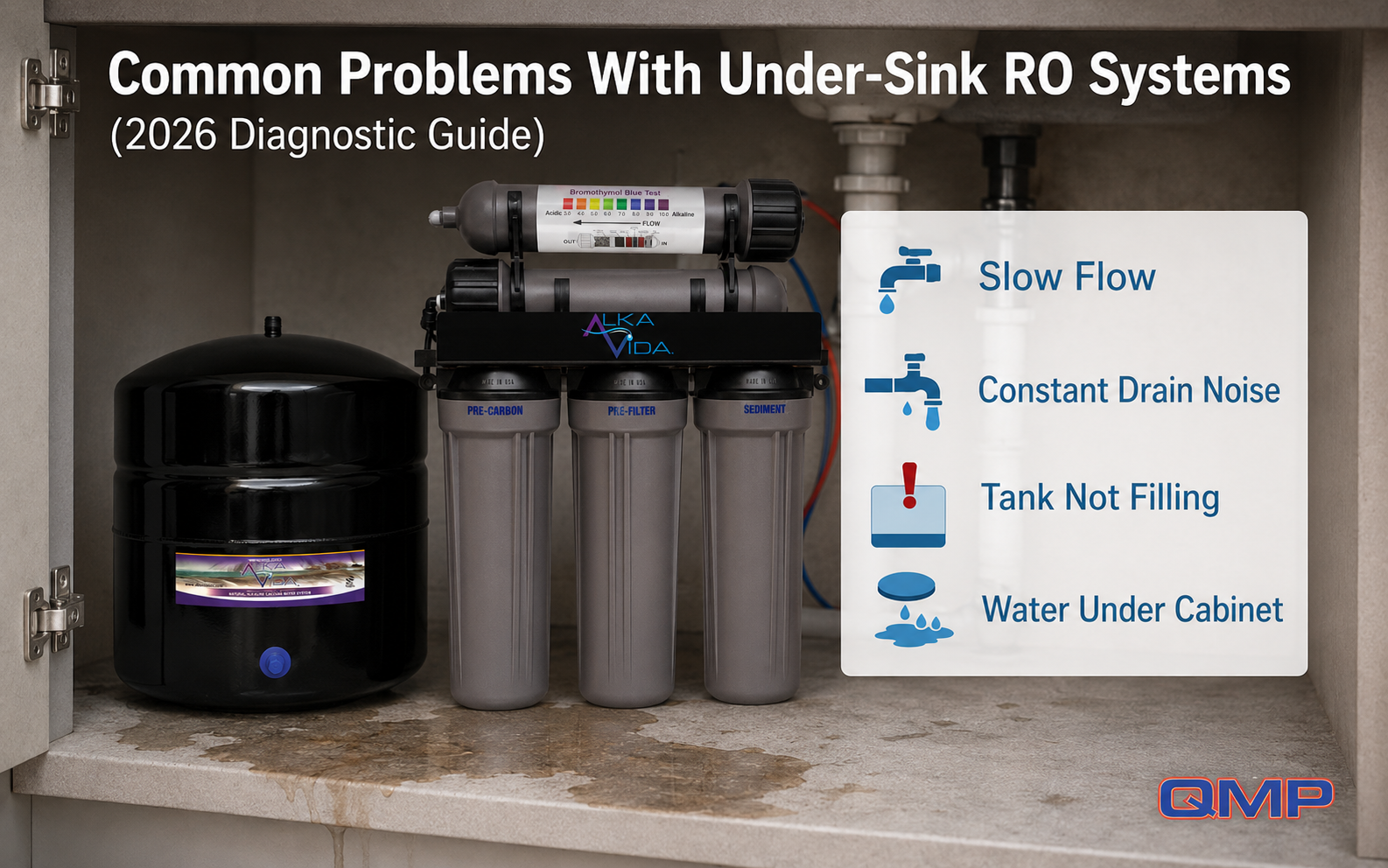
This is where that mineral tradeoff from earlier gets answered. QMP’s residential reverse osmosis systems, the ALKA line, are built around alkaline water technology the company has developed since the nineties, so the water comes out remineralized instead of flat and stripped. For the quirks of under-sink setups specifically, there is a separate guide on common under-sink RO problems.
| Not sure which setup makes sense for your kitchen and your water? That is worth sorting out before committing to anything, and you can see how and where these systems are built if you want the full picture first. |
How to spot a real system from a rebranded import
There is a fast way to protect yourself before you spend the money. You do not need to be an engineer to separate a manufactured system from a rebranded import; you just need to know what to look for. A few checks will tell you most of what you need.
- Look for NSF/ANSI 58, the standard written specifically for reverse osmosis drinking water systems.
- Check for NSF 372 certification, which confirms the components meet lead-free requirements.
- Ask where the system is manufactured, and see whether the seller can actually answer.
- Find out who supplies the replacement parts, and whether they will still exist in five years.
A manufacturer can answer all of those without hesitating, while a reseller usually cannot. If you want to go deeper on the materials question, there is a full breakdown of what water filters are made of.
What it costs, and what upkeep looks like
Price is worth being straight about, since it trips people up. A cheap under-sink filter and a certified reverse osmosis system are not the same purchase, and the gap in price reflects a gap in materials and testing. A properly built residential system usually starts around $800, and QMP’s systems generally run from roughly $800 to over $1,000 depending on the number of stages and the components inside. Upkeep is simpler than most people expect, and it follows a predictable schedule.
- Sediment and carbon filters usually need changing every six to twelve months.
- The RO membrane typically lasts two to three years before it needs replacing.
- A well-built system, maintained on schedule, generally lasts eight to twelve years.
That maintenance rhythm is also where cheaper systems quietly cost you more, because hard-to-source filters and short membrane life add up over the years you own the thing.
The bottom line
If there is one thing to take from all of this, make it this. A spec sheet tells you what a reverse osmosis system claims to do on the day you buy it, and the manufacturer tells you whether it will still be doing it in five years. Stages and price matter, but they sit downstream of who built the system and whether anyone stands behind it. That is the standard QMP builds to, and it is the question worth asking of any brand before you buy.
Frequently asked questions
What does a reverse osmosis system remove?
A reverse osmosis system removes lead, PFAS, arsenic, nitrate, chlorine, and fluoride, along with most other dissolved solids. It works at a molecular level, which is why it reaches contaminants that carbon pitchers and fridge filters leave behind.
Is reverse osmosis water safe to drink?
Yes, and it is among the cleanest water you can get at home. The one caveat is that it strips out beneficial minerals too, which is why systems like QMP’s ALKA line add a remineralization stage.
How long does a reverse osmosis system last?
A well-built reverse osmosis system generally lasts eight to twelve years when it is maintained on schedule. Build quality is the deciding factor, since the housings, fittings, and membrane all wear at different rates.
Are American-made reverse osmosis systems better than imported ones?
In most cases, yes, because a U.S. manufacturer can control materials, hold one quality standard, and keep replacement parts available for years. The difference tends to show up over time, in reliability and in whether anyone stands behind the system when something goes wrong.
How often should you change reverse osmosis filters?
Most sediment and carbon filters need changing every six to twelve months, depending on your water. The membrane usually lasts two to three years before it needs replacing.
How much does a good reverse osmosis system cost?
A properly built residential system usually starts around $800 and can run past $1,000 depending on stages and components. The price reflects certified materials and real testing, which is what sets it apart from a cheap filter.