Skip to content
I grew up around water filtration the way some kids grow up around a family business. My dad started building American made water filtration systems back in 1994, so filters and the certifications behind them were part of the everyday conversation in my house growing up.
So when someone chooses a filter mostly because the box says ‘certified,’ I understand the thought process, and I also know how often it points people the wrong way. An NSF certified water filter proves something specific, and the gap between what it covers and what shoppers assume it covers is where most regrettable purchases happen.
The thing that gets lost is simple: A certification is a tested promise about one claim on one model, not a blanket grade saying the filter handled everything floating in your glass. Once that distinction clicks, the rest of this gets easier, and you stop paying extra for a sticker that covers less than you pictured.
So what does “certified” actually mean?
NSF is an independent organization that writes public health standards and then checks products against them. Earning an NSF certified water filter seal means a company submits a product, declares exactly which contaminants it claims to reduce, and pays for the water filter testing that either backs that claim or doesn’t. Pass, and the unit is certified for those specific claims and nothing more.
That last part is where a lot of people stumble. A filter can be NSF certified to remove chlorine, not actually remove chlorine or other contaminants, and still maintain its label. The manufacturer can choose what to test for, not what the filter actually removes.That’s how two completely different filters can be labeled as NSF Certified while filtering several substances.
The water filter certifications that matter at home
Most of the alphabet soup on filter boxes traces back to a short list of NSF/ANSI standards. These are the water filter certifications worth recognizing before you spend a dollar.
| Standard | What it covers | What to look for |
| NSF/ANSI 42 | Taste, odor, chlorine, and particulates. Aesthetic only. | Better-tasting water, not health protection by itself. |
| NSF/ANSI 53 | Health contaminants like lead, certain VOCs, and PFAS (folded in from the old P473). | The standard to demand if contaminants, not flavor, are your worry. |
| NSF/ANSI 58 | Reverse osmosis systems. Requires total dissolved solids reduction and can cover arsenic, fluoride, and nitrates. | The one that counts for a serious under-sink RO setup. |
| NSF/ANSI 401 | Emerging contaminants such as trace pharmaceuticals and pesticides. | A useful extra layer, common on higher-end systems. |
| NSF/ANSI 372 | Low-lead material content. | Confirms the parts touching your water are low-lead, which ties back to what your filter is built from. |
NSF 42 vs NSF 58, since people keep asking
This comparison comes up a lot, and the two standards aren’t competing for the same job. NSF 42 deals with how your water tastes and smells. NSF 58 covers an entire reverse osmosis system and the dissolved contaminants it pulls out, which sits in a different league of protection. A unit carrying only 42 has bought you better flavor. A unit carrying 58 alongside 42 and 53 has bought you a system that handles the things you were actually worried about. When friends ask me which one is better, I tell them they’re asking the wrong question, because a strong RO system should hold all three rather than force a choice between them.
| Curious how a fully certified residential setup is put together? Browse the QMP residential systems and components and read the standards listed on each one before you compare anything else. |
NSF isn’t the only name on the seal: WQA and IAPMO
Here’s where it gets confusing for a lot of buyers. The NSF creates water quality standards, but it isn’t the organization to certify. The Water Quality Association and IAPMO run their own independent water filter testing programs and certify using the same NSF/ANSI benchmarks. A WQA certified filter tested against NSF/ANSI 53 is held to the identical standard. A seal from any of the three is valid, as long as you check which standard and which contaminants it actually covers.
What you don’t want to do is treat the logo as the finish line. The logo tells you who did the testing. The standard and the contaminant list tell you what you’re getting.
How to verify a certification in about a minute
This is the step almost no other article walks you through, and it’s the most useful thing I can hand you. You don’t have to take the box at its word. You can confirm an NSF certified water filter yourself, for free, in roughly a minute.
- Find the model number on the unit, the manual, or the performance data sheet.
- Open the certifier’s public listing. NSF publishes a guide to its water treatment standards, and WQA and IAPMO maintain their own searchable databases.
- Search the brand or model and read the entry. It spells out the standards held and the contaminants the product is certified to reduce.
- If the model isn’t listed, or the listing covers a different model than the one in your hands, treat the claim as marketing until you can prove otherwise.
A minute of this saves people from products that lean on phrases like “tested to NSF standards” without ever finishing certification.
“Tested to” is not “certified,” and other label games
Once you know how to verify, the wording on packaging starts to read differently. A few phrases that sound like certification simply aren’t:
- “NSF tested” or “tested to NSF standards” means a company ran some form of a test, often on its own, which isn’t the same as third-party certification.
- “Meets NSF standards” is a self-declared claim with nobody independently signing off behind it.
- A certified component is not a certified system. A brand can certify one cartridge or one material, then let the packaging imply the whole unit earned it.
None of this is against the rules, and not every brand using soft language is cutting corners. Third-party certification is slow and costs money, which is why low quality imported products skip to the finish line using language to sway potential buyers into purchasing subpar systems. Read a box through that lens and the water filter safety standards a product has earned become much easier to separate from the ones it’s only hinting at.
Knowing where your system is manufactured matters
Now the part I care about most, because it’s the piece hardly anyone explains. A certification is a snapshot of one tested unit, on one day, doing what the company claimed. Consistent manufacturing is what’s supposed to keep every unit matching that initial snapshot – and that’s where much of the market quietly breaks down.
Most brands you find online don’t manufacture much; they assemble. Parts get sourced from overseas suppliers, bolted together, branded, and shipped, separating quality between batches due to the lack of creative and manufacturing control. A certification earned on an early sample doesn’t guarantee the unit in your cart was built to the same spec.
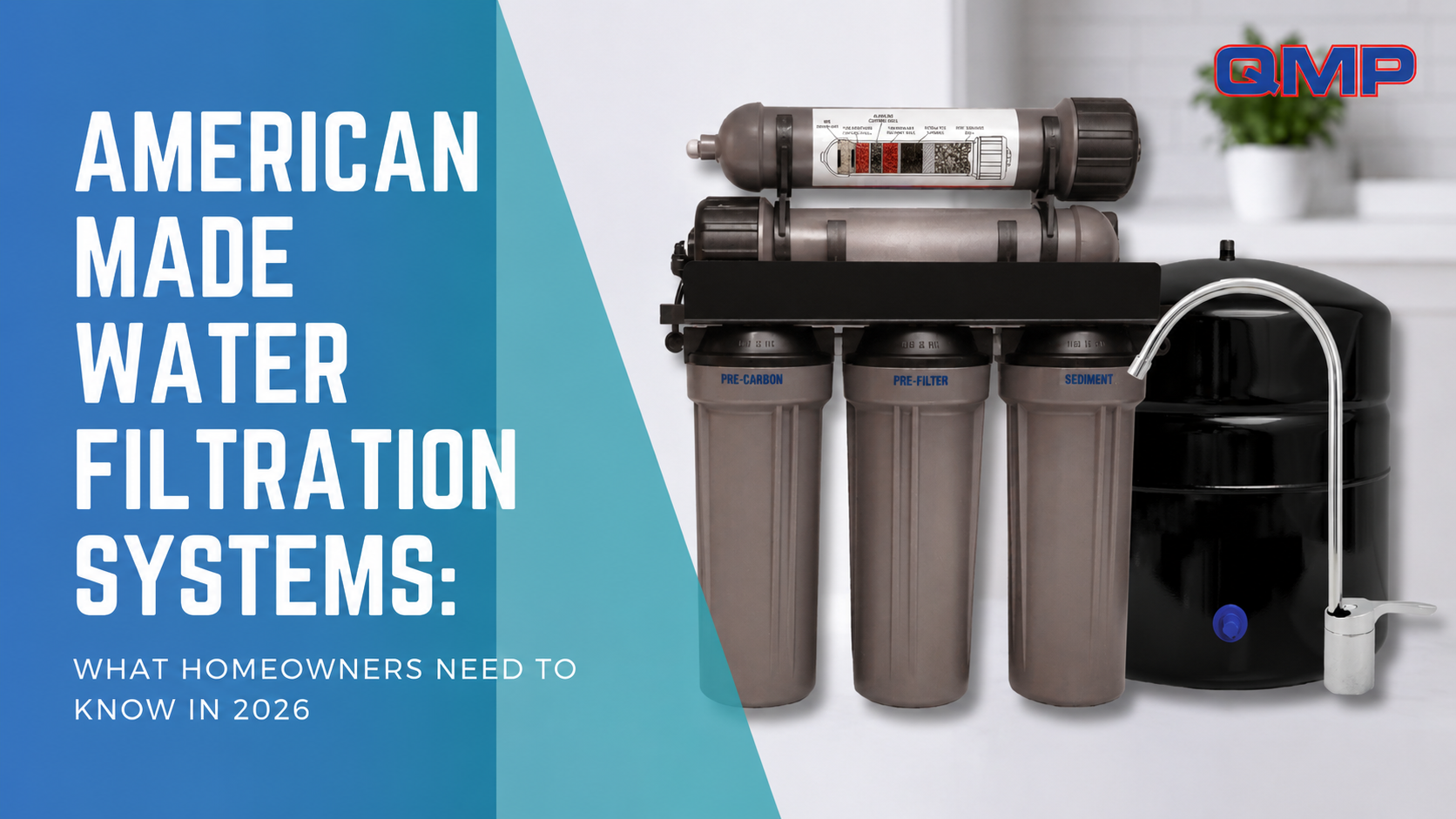
My dad’s company runs differently than other companies. QMP manufactures vertically in the United States, so the housings, faucets, cartridges, and reverse osmosis units are built in-house rather than assembled from a catalog of imported parts. When one company molds, machines, assembles, and tests under its own roof, the unit that earned the certification and the one that ships are one and the same. An NSF certified water filter is only as steady as the plant standing behind it.
People also expect a strong reverse osmosis system to cost about as much as a pitcher. A residential RO system built to the standard I’m describing generally starts around eight hundred dollars and climbs from there, and that figure reflects certified components, better materials, and a unit that won’t fail within a year.
| Not sure which standards your home water actually calls for? You can talk it through with the QMP team and match the certifications to your situation instead of guessing in a store aisle. |
What to check before you buy
- Confirm NSF/ANSI 53 if lead or other health contaminants concern you, not only 42.
- Look for NSF/ANSI 58 on any reverse osmosis system.
- Verify the exact model in NSF, WQA, or IAPMO’s public listing.
- Make sure the certification covers the whole system, not a single part.
- Check who built it and where, because a certification stays only as reliable as the manufacturing behind it.
Get those five right and you’ve already done more homework than most buyers ever do.
Frequently asked questions
Are all water filters the same?
No, water filters are not all the same, and the differences decide how protected your water is. A pitcher that reduces chlorine taste and a reverse osmosis system certified to NSF/ANSI 58 do entirely different jobs. Filters vary by the contaminants they’re certified to remove, the standards they meet, and how reliably each unit is made.
What makes a water filter safe?
A water filter is safe when three things line up: it’s certified to remove the specific contaminants in your water, the materials touching your water are low-lead and food-safe, and the production behind it is consistent enough that every unit matches the one that earned certification. A seal on its own, without those, doesn’t finish the job.
What does an NSF certified water filter actually remove?
An NSF certified water filter removes only the contaminants named in its certification. One certified to NSF/ANSI 42 reduces chlorine, taste, and odor. One certified to NSF/ANSI 53 addresses health contaminants like lead and certain VOCs. Always read which standard the seal refers to before assuming anything.
What does NSF 42 certified mean?
NSF 42 certified means the filter was independently tested to reduce aesthetic problems in your water, mainly chlorine, taste, odor, and some particulates. It says nothing about lead, PFAS, or other health contaminants, which fall under NSF 53 or NSF 58 instead.
How do I know if my water filter is NSF certified?
Find the model number, then search it in NSF’s public certified products database, or WQA’s or IAPMO’s if one of those issued the seal. The listing shows the exact standards and contaminants the filter is certified for. If your model isn’t listed, it isn’t certified, whatever the box suggests.
Is NSF 42 or NSF 58 better?
They serve different purposes, so neither wins outright. NSF 42 improves taste and odor, while NSF 58 covers a reverse osmosis system that removes dissolved contaminants like arsenic, fluoride, and nitrates. For health protection, NSF 58 paired with NSF 53 does far more than 42 on its own.
A certification is a starting point, not a guarantee, and reading one well is a skill worth having before you trust a filter with your family’s water. Learn what the seal covers, confirm it yourself, and pay attention to who actually built the thing. Do that, and the box stops being a sales pitch and starts being information you can use.